
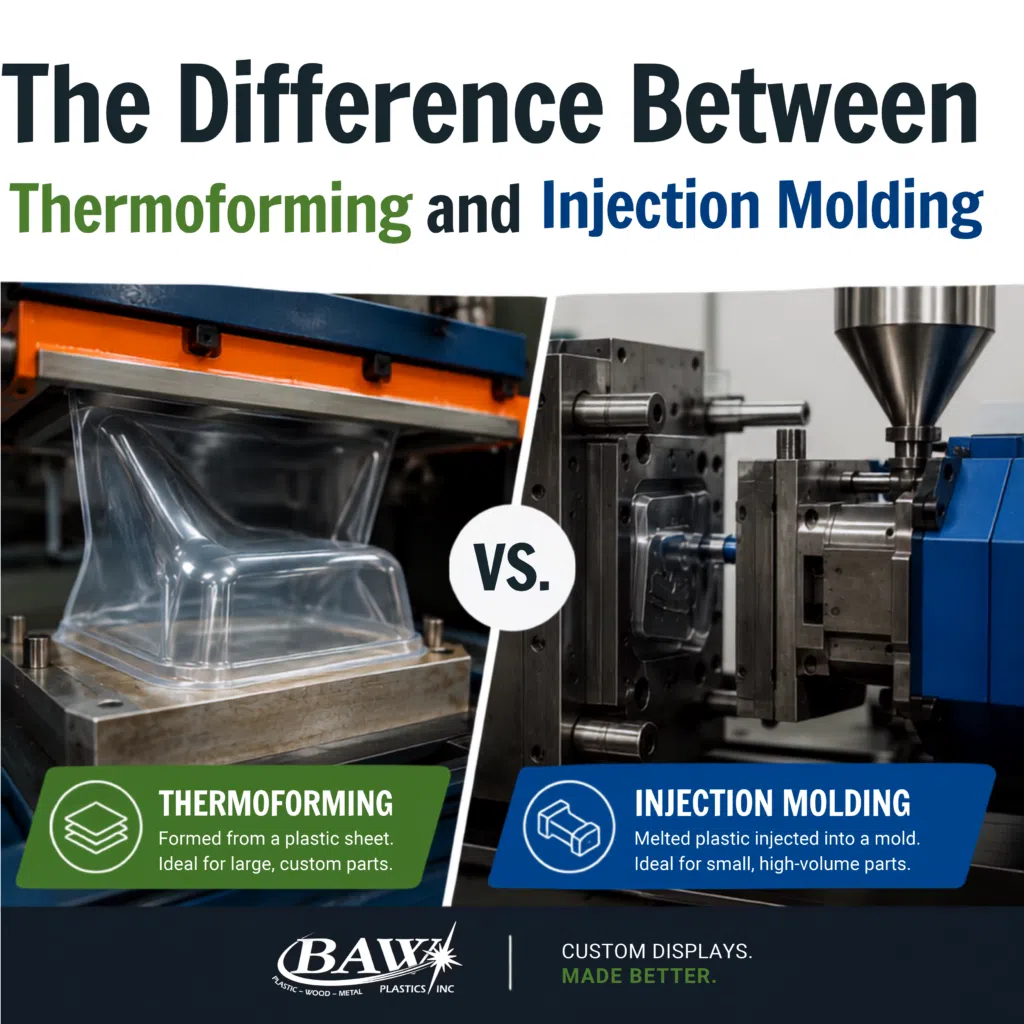
Plastic manufacturing is not one-size-fits-all. The process used to create a plastic part has a direct impact on cost, lead time, design flexibility, and the finished product’s performance in the real world. For brands investing in custom retail displays, understanding which manufacturing process is right for the job is an important part of making a smart, informed investment.
At BAW Plastics, thermoforming is at the core of what we do. We have spent more than 40 years manufacturing custom retail displays and components using this process — and understanding why thermoforming is the right choice for so many retail display applications starts with understanding how it compares to the other major plastic manufacturing method: injection molding.
How Thermoforming Works
Thermoforming is the process of forming a heated plastic sheet to the surface of either a male or female mold. It is a single-sided plastic fabrication process — only one side of the plastic sheet is controlled by the mold or tool. Vacuum forming and pressure forming are both popular styles of thermoforming. Vantageplastics
In the tooling phase of thermoforming, a single 3D form is created out of aluminum, wood, polyurethane, or a 3D printer. This relatively simple tooling process is one of thermoforming’s most significant advantages — it is faster to produce, easier to modify, and considerably less expensive than the tooling required for injection molding. Polymershapes LA
The result is a manufacturing process that is highly adaptable, cost-effective for custom and mid-volume production runs, and well suited for producing large, complex parts with excellent surface finishes and a wide range of material options.
How Injection Molding Works
Injection molding involves melting plastic pellets and injecting them into a mold, where they cool and solidify into the desired shape. Unlike thermoforming, injection molding uses a double-sided mold — meaning both sides of the finished part are controlled by the tool, which allows for greater precision and more intricate geometries. Advanced Plastiform
However, injection molding comes with high tooling and equipment costs that can be a barrier to entry for some companies, as well as long lead times for mold building and repair due to the complexities of the shapes typically being molded. These factors make injection molding a better fit for high-volume production of small, highly precise parts — but a less practical choice for the kinds of large, custom display components that BAW Plastics specializes in. Spartech
Key Differences at a Glance
Understanding the practical differences between the two processes helps clarify when each is the right choice.
Tooling costs — Unlike injection molding, which requires expensive steel or aluminum molds, thermoforming uses simpler tooling, significantly lowering upfront costs. This makes thermoforming a more accessible and cost-effective option for custom retail display projects, particularly those involving larger components or shorter production runs. Advanced Plastiform
Lead times — Thermoforming takes a total production time of approximately 14 weeks, with 8 weeks for tooling and 6 weeks for production. Injection molding takes a total of approximately 24 weeks, requiring 16 weeks of tooling and 8 weeks of production. For brands working toward retail launch deadlines, that difference in lead time is significant.
Design flexibility — Since thermoforming uses a simple single-sided mold made from highly formable materials, thermoform designs can be modified quickly and with minimal cost. This is a critical advantage for custom retail display projects, where design adjustments are common as brands refine their concepts before going into full production. Vantageplastics
Part size — Thermoforming is best for creating large parts and consolidating multiple parts into a single part. Injection molding, by contrast, is better suited for small, intricate parts with tight dimensional tolerances. For retail displays — which tend to be large, complex, and highly customized — thermoforming is the natural fit.
Surface finish — Plastic made through thermoforming can be used without painting afterwards, while injection molding may require a coat of paint to look finished. For retail display applications where aesthetics are critical, thermoforming’s ability to produce a clean, finished surface straight from the mold is a meaningful advantage.
Production volume — Thermoforming is ideal for smaller production quantities, typically between 250 and 3,000 parts per year. Injection molding is commonly selected for high-volume production with intricate features. For brands producing custom retail displays in quantities that fall within the thermoforming range, the cost and lead time advantages are clear. VantageplasticsProlean MFG
When Injection Molding Is the Right Choice
It is worth noting that injection molding is not the wrong choice — it is simply the right choice for a different set of applications. Injection molding is ideal for manufacturing small, complex parts that require extreme precision and accuracy, such as engine components, microfluidics, and medical devices. For industries where tight tolerances and high volumes are non-negotiable, injection molding delivers results that thermoforming cannot match. Borkemold
For brands in the retail display space, however, the scale, customization, and design flexibility requirements of most projects make thermoforming the more practical and cost-effective solution.
Why Thermoforming Is the Right Choice for Custom Retail Displays
At BAW Plastics, we chose thermoforming as our primary manufacturing process for a reason. The characteristics that make thermoforming stand out — lower tooling costs, faster lead times, design flexibility, the ability to produce large and complex parts, and excellent surface finishes straight from the mold — align directly with what custom retail display manufacturing demands.
The ability to choose from a wide range of plastics makes thermoforming ideal for various applications. The clarity, rigidity, and impact resistance of plastics can be tailored to meet specific needs, and the ability to incorporate varying levels of detail and texture allows for the creation of customized parts. At BAW, we work with materials including acrylic, PETG, HIPS, polycarbonate, and ABS — giving our customers the flexibility to choose the material that best fits their display’s performance and aesthetic requirements. Borkemold
For brands investing in custom retail displays, thermoforming offers something that injection molding simply cannot match at the same cost and lead time: the ability to produce large, visually striking, highly customized display components that are ready to represent a brand on the retail floor from day one.
Contact us today to discuss your next project and bring your ideas to life! Contact Us | BAW Plastics Inc. | Custom Retail Displays
Sources:
- Xometry — Injection Molding vs. Thermoforming: Differences and Comparisons.
🔗 https://www.xometry.com/resources/injection-molding/injection-molding-vs-thermoforming/ - Ponoko — Thermoforming vs. Injection Molding: Differences Explained Simply.
🔗 https://www.ponoko.com/blog/injection-molding/thermoforming-vs-injection-molding/ - The Rodon Group — Thermoforming vs. Injection Molding: What’s the Difference?
🔗 https://www.rodongroup.com/blog/thermoforming-vs-injection-molding/ - Spartech — Thermoforming vs. Injection Molding.
🔗 https://www.spartech.com/blogs/Thermoforming-Vs-Injection-Molding - Advanced Plastiform — Thermoforming vs. Injection Molding.
🔗 https://advancedplastiform.com/blog/thermoforming-vs-injection-molding/ - Vantage Plastics — Thermoforming vs Injection Molding.
🔗 https://vantageplastics.com/thermoforming-vs-injection-molding - Prolean Manufacturing — Thermoforming vs. Injection Molding: Comparisons to Consider.
🔗 https://proleanmfg.com/blog/thermoforming-vs-injection-molding/ - Polymershapes — Thermoforming vs. Injection Molding.
🔗 https://www.polymershapesfab.com/thermoforming-vs-injection-molding-polymershapes-explains-the-difference/
